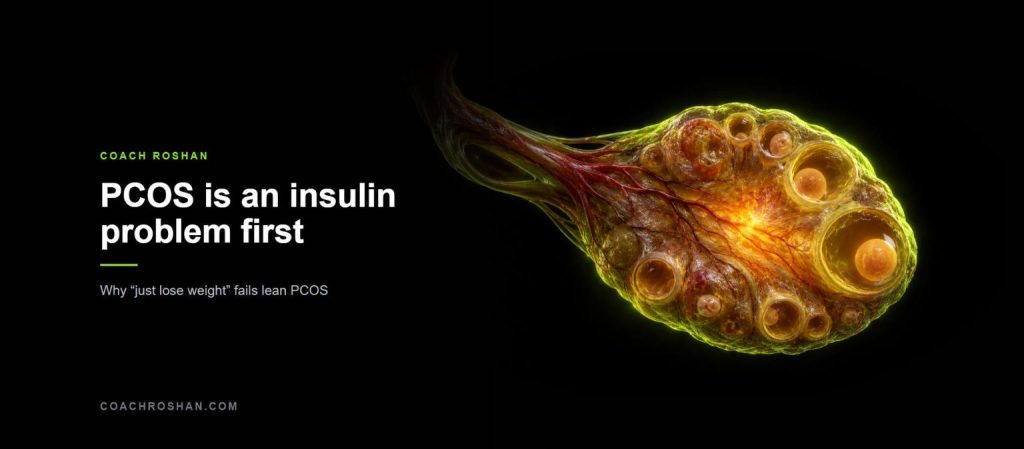
The standard advice for PCOS is to lose weight. It is not wrong, exactly. It is just the last step of an explanation, delivered without the first three — which is why it so often fails, and why it fails hardest for women who are not overweight to begin with.
PCOS affects somewhere around 10–13% of women. It is the most common hormonal condition in women of reproductive age. And for a large share of them, the thing driving it is insulin.
PCOS and insulin, at a glance
What insulin resistance actually means
Insulin’s job is to move glucose out of your blood and into your cells. Insulin resistance means your cells have stopped responding properly, so your pancreas compensates by producing more.
Your blood sugar can look completely normal on a routine test while this is happening. That is the point — it stays normal because insulin is running high to keep it there. A fasting glucose alone will miss it.
In the ovary, persistently high insulin drives increased androgen production. Higher androgens produce the symptoms that brought you in: irregular or absent periods, acne along the jaw, hair where you do not want it, hair loss where you do, and difficulty conceiving.
That is the mechanism. Weight is often part of the loop — it can worsen insulin resistance, and insulin resistance makes weight harder to shift — but it is not the origin of the chain.
The chain, in order
Your cells stop responding properly to insulin
The pancreas compensates by producing more of it
Blood sugar still looks completely normal on a routine test — it stays normal because insulin is running high to keep it there
In the ovary, persistently high insulin drives increased androgen production
Higher androgens produce the symptoms that brought you in: irregular or absent periods, acne along the jaw, hair changes
Weight is often part of the loop — it can worsen insulin resistance, and insulin resistance makes weight harder to shift — but it is not the origin of the chain.
Which is why “just lose weight” fails lean PCOS
Here is the finding that should change the conversation: women with PCOS are more likely to have insulin resistance irrespective of BMI. Lean women with PCOS and an entirely normal BMI still carry increased risk of insulin resistance and cardiometabolic disease.
If you have PCOS at a normal weight, you have probably been dismissed at least once. Told you cannot have it because you are not overweight. Told to lose weight you do not have.
The insulin problem can be there regardless. The plan should address the mechanism, not the scale.
Been told to lose weight and left with nothing more specific? Send me your reports and I will tell you what is actually worth measuring.
Why “just lose weight” fails lean PCOS
What the advice assumes
- That the weight came first and caused the PCOS
- That a normal BMI means insulin resistance is not there
- That a normal fasting glucose rules it out
What the evidence shows
- Women with PCOS are more likely to have insulin resistance irrespective of BMI
- Lean women with PCOS and an entirely normal BMI still have it
- The target is the mechanism, not the scale: protein, fibre, resistance training and sleep
What is worth measuring
Things worth discussing with your doctor or gynaecologist, depending on your history:
- Fasting insulin alongside fasting glucose — the pair is far more revealing than glucose alone
- HbA1c, for a longer view of blood sugar
- Thyroid function, because thyroid disorders mimic and coexist with PCOS
- Vitamin D, commonly low and relevant to insulin sensitivity
- Lipids, given the cardiometabolic risk that accompanies PCOS
The 2023 International Evidence-based Guideline sets out a sequential approach to diagnosis — clinical and biochemical assessment first, with ultrasound or anti-Müllerian hormone used selectively in adults rather than reflexively. An ultrasound alone neither confirms nor excludes it.
What is worth measuring
| Test | Why it earns its place |
|---|---|
| Fasting insulin alongside fasting glucose |
The pair is far more revealing than glucose alone — and glucose alone is what most panels give you |
| HbA1c | A longer view of blood sugar than a single morning reading |
| Thyroid function | Thyroid disorders both mimic and coexist with PCOS |
| Vitamin D | Commonly low, and relevant to insulin sensitivity |
| Lipids | Given the cardiometabolic risk that accompanies PCOS |
What actually helps
Nutrition genuinely does move insulin sensitivity. But the useful version is more specific than “eat less”.
Protein and fibre at every meal. Both blunt the glucose rise, which blunts the insulin rise. This is usually the single highest-yield change, and it involves adding food rather than removing it.
Carbohydrates in context, not in exile. Rice and roti are not the enemy. Rice eaten alone spikes harder than the same rice with dal, vegetables and curd. You do not have to give up your staples; you have to stop eating them naked.
Resistance training. Muscle is where most glucose gets disposed of. More muscle means more capacity to clear glucose without demanding more insulin. Two sessions a week does real work.
Sleep. A few nights of short sleep measurably reduces insulin sensitivity in healthy people. If you are managing everything else and sleeping five hours, you are working against yourself.
Consistency over intensity. PCOS responds to sustained change. A punishing plan you abandon in three weeks is worth less than an unremarkable one you keep for a year.
What I will not tell you
That PCOS can be cured. It cannot. It can be managed, sometimes very well — cycles returning, symptoms easing, bloodwork improving — but anyone promising a cure is selling something.
That you should stop your metformin, your oral contraceptive, or anything else you were prescribed. That is between you and your doctor, and PCOS is a condition where medication and nutrition usually work best together rather than as alternatives.
That nutrition replaces a gynaecologist. If you are trying to conceive, or your periods have stopped entirely, you need proper medical care alongside any dietary work.
The short version
- PCOS affects roughly 10–13% of women and is frequently insulin-driven
- Insulin resistance occurs regardless of BMI — lean PCOS is real and commonly dismissed
- Normal fasting glucose does not rule it out; fasting insulin is the more revealing test
- Protein, fibre, resistance training and sleep target the mechanism directly
- It is manageable, not curable, and nutrition works alongside medical care rather than instead of it
Before you act on any of this
I am a pharmacist and a nutritionist. I am not your doctor, and this article is general information rather than advice about you specifically. Nothing here is a reason to start, stop or change a prescribed medicine — that decision belongs to the person who prescribed it, working from your history and your bloodwork. What this article can do is tell you which questions are worth asking at your next appointment.