The scan report says grade 1 fatty liver, clinically correlate. Nobody explains what to correlate it with. The doctor says to cut oil and lose some weight, and that is the end of the conversation. So the report goes into a drawer, and three years later it says grade 2.
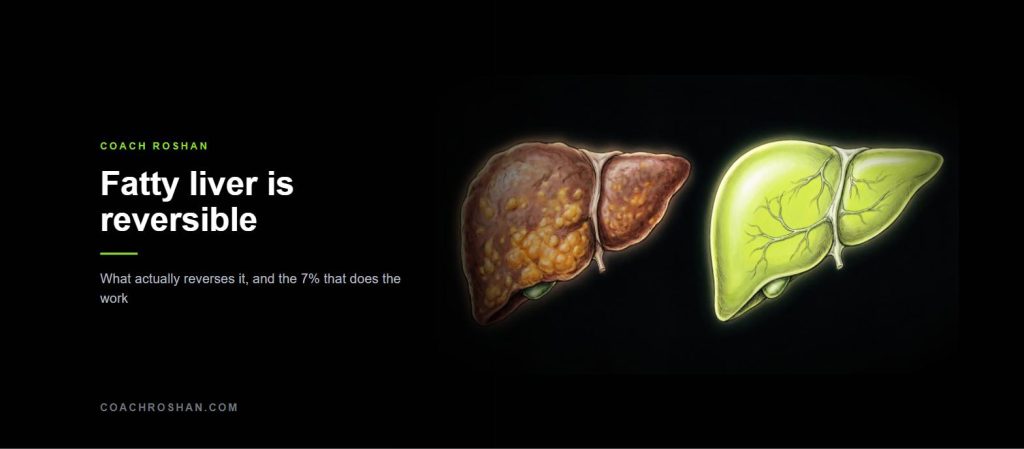
This is the most common metabolic finding I see in intake bloodwork, and it is also the most casually dismissed — by patients, because nothing hurts, and sometimes by the system, because there was no drug to offer. Both of those reasons have expired. Fatty liver is reversible at the stage most people are diagnosed, the amount of change required is specific and measurable, and there is now a real cost to ignoring it.
Fatty liver at a glance
The name changed, and the change tells you what it is
Until 2023 this was called non-alcoholic fatty liver disease — NAFLD. It is now MASLD: metabolic dysfunction-associated steatotic liver disease. That is a mouthful, but the rename was not cosmetic.
The old name defined the condition by what it was not. You had fatty liver, you did not drink much, therefore — non-alcoholic. It said nothing about the cause. The new name defines it by what it is: fat in the liver occurring alongside metabolic dysfunction, meaning at least one of raised waist circumference, raised blood sugar or diagnosed type 2 diabetes, raised blood pressure, raised triglycerides, or low HDL.
Read that list again, because it is the whole point. Fatty liver is not a liver problem that happened to arrive on its own. It is the liver’s share of a metabolic problem that is also showing up in your blood pressure, your triglycerides and your fasting glucose. Treating it as an isolated organ finding is why so many people get nowhere. The liver is a fuel-storage organ that has run out of somewhere to put the fuel.
Old name vs new name
NAFLD — until 2023
- Defined by what it is not: you have liver fat and you do not drink much
- Says nothing about the cause
- A diagnosis of exclusion
- Frames it as an isolated liver finding
MASLD — from 2023
- Defined by what it is: liver fat alongside metabolic dysfunction
- Requires at least one of raised waist, raised blood sugar or type 2 diabetes, raised blood pressure, raised triglycerides, low HDL
- A diagnosis of inclusion
- Frames it as one symptom of a whole-body problem
The rename is the diagnosis. Every criterion on the right also shows up on a standard blood report.
The inflamed version — where the fat has started causing damage rather than just sitting there — is MASH, formerly NASH. That distinction matters, because fat alone is largely harmless and fibrosis is not.
What grade 1, 2 and 3 actually mean
Almost everyone is diagnosed on an ultrasound, and almost everyone misreads the grade. Ultrasound grading describes how bright the liver looks compared with the kidney. It is an estimate of how much fat is present. It is not a measure of damage.
The thing that predicts whether you get into trouble is fibrosis — scarring — and ultrasound grading does not measure it. Someone can carry grade 2 fat with no meaningful scarring, and someone else can carry grade 1 with early fibrosis. Chasing the grade number down is not the goal; it is a proxy at best.
Two things assess it better, and one of them is free:
- FIB-4. Calculated from your age, AST, ALT and platelet count — all of which are probably already sitting in a report you have. It is a validated first-pass screen for advanced fibrosis. A low score is genuinely reassuring. An indeterminate or high score is a reason to be referred, not a reason to panic.
- Transient elastography (FibroScan). Measures liver stiffness directly, takes ten minutes, no needle. Increasingly available in Indian metros and standard in the US, UK and Canada. This is the test worth asking for if FIB-4 comes back unclear.
What each test actually sees
Ultrasound grade
- Measures how bright the liver looks next to the kidney
- An estimate of how much fat is present
- Does not measure damage
- Grade 1 can carry early fibrosis; grade 2 can carry none
FIB-4 and elastography
- Estimate scarring, which is what predicts outcomes
- FIB-4 uses age, AST, ALT and platelets — already in reports you have
- Elastography measures liver stiffness directly in about ten minutes
- A low FIB-4 is genuinely reassuring
Also worth knowing: normal ALT does not rule this out. Plenty of people with MASH have liver enzymes inside the reference range. A normal LFT is not a clean bill of liver health, which is one of several reasons a standard annual package can miss things — something I have written about in the tests your annual health package leaves out.
The number that reverses it is 7 to 10 percent
Here is the part that almost never gets said out loud in the consultation, and it is the single most useful thing in this article. The response to weight loss is dose-dependent, and the doses are known:
- 3 to 5 percent of body weight is enough to reduce liver fat measurably.
- 7 percent is roughly where steatohepatitis — the inflammation — resolves in a large share of people.
- 10 percent or more is where fibrosis starts to regress, which is the outcome that actually changes your long-term risk.
The dose-response of weight loss
Liver fat falls measurably
Steatohepatitis — the inflammation — resolves in a large share of people
Fibrosis begins to regress. This is the outcome that changes your long-term risk
For a 92 kg man, 7 percent is about 6.5 kg. Not 25 kg. Not a transformation. Six and a half kilograms, held. That is a very different conversation from “lose weight”, and it is the reason I always convert the advice into a number before anyone starts.
The catch is the word held. Liver fat comes back quickly when the weight does, and it comes back faster than it left. A crash diet that gets you to 7 percent and then unravels leaves you worse off than a slower loss you can defend, because the regain typically arrives with less muscle than you had before.
Your 7% and 10%, in kilograms
| If you weigh | 7% is | 10% is |
|---|---|---|
| 60 kg | 4.2 kg | 6.0 kg |
| 70 kg | 4.9 kg | 7.0 kg |
| 80 kg | 5.6 kg | 8.0 kg |
| 90 kg | 6.3 kg | 9.0 kg |
| 100 kg | 7.0 kg | 10.0 kg |
| 110 kg | 7.7 kg | 11.0 kg |
Find your row before you start. “Lose weight” is not a target. 6.3 kg, held for a year, is.
What to change, in order of return
Liquid sugar first. Fructose is metabolised largely in the liver, and the form that causes the most trouble is the form that arrives fast and without fibre — sweetened drinks, packaged juices, energy drinks, sweetened coffee. Whole fruit is not the problem here and does not need removing.
Refined carbohydrate load second. Not “carbs are bad” — the realistic Indian version of this is portion size and refinement of the staple, plus what is eaten alongside it. Adding protein and fibre to the same plate blunts the glucose response without requiring anyone to abandon rice or roti.
Alcohol, even though the old name said it was not the cause. Absence of heavy drinking is what let you be diagnosed with the non-alcoholic version. It does not mean your existing intake is neutral on top of an already fatty liver. The two mechanisms stack.
Resistance training, which works partly independently of weight loss. Muscle is the largest site of glucose disposal you own. Building it reduces liver fat even when the scale barely moves — which is exactly what you need on the weeks the scale does nothing. If you are starting from zero, start with weights rather than the treadmill.
Coffee, genuinely. Two to three cups a day is consistently associated with less fibrosis progression across large cohorts. Unsweetened, obviously, or you have just undone the first point.
Sleep, because it sets the ceiling on everything above. Short sleep raises appetite and worsens insulin sensitivity, and it is usually the reason an otherwise sound plan quietly stops working.
The drugs are real now, and they are still not step one
For twenty years there was no approved drug for this. That changed twice in quick succession:
Resmetirom was approved in March 2024 — the first drug licensed specifically for MASH with fibrosis. Semaglutide (as Wegovy) followed in August 2025, approved for adults with non-cirrhotic MASH and moderate to advanced fibrosis. In its trial, 63 percent achieved resolution of steatohepatitis without worsening fibrosis, against 34 percent on placebo, over 72 weeks.
Semaglutide vs placebo in MASH, 72 weeks
ESSENCE trial, the basis of the August 2025 approval. Note the indication: non-cirrhotic MASH with F2–F3 fibrosis, not a grade 1 ultrasound report.
Those are meaningful numbers and it is a genuinely different era. But read the indication carefully: moderate to advanced fibrosis, non-cirrhotic. That is not most people holding a grade 1 ultrasound report. If your FIB-4 is low and you have simple steatosis, you are not the patient in that trial, and the intervention with the best evidence for you is still the 7 percent. What the price collapse in generic semaglutide has changed is access, not the indication.
On supplements, because I get asked every week: vitamin E has evidence in a narrow group — biopsy-proven MASH without diabetes — and is a decision for a hepatologist, not a shelf. Silymarin and the various “liver detox” formulations do not have the evidence their marketing implies. Nothing you buy off a counter substitutes for the weight, the training or the sugar.
What to actually get tested
If you have been told you have fatty liver and handed nothing else, this is a reasonable list to take to your doctor: LFT including AST, ALT and GGT; a full blood count for platelets (so FIB-4 can be calculated); fasting glucose and HbA1c; a fasting lipid profile including triglycerides and HDL; and waist circumference measured properly rather than estimated from trouser size. If FIB-4 is indeterminate or high, ask about elastography. If the HbA1c comes back in the borderline band, the prediabetes numbers are worth reading properly.
What to take away
- The rename to MASLD tells you the diagnosis: this is metabolic, and the liver is one symptom of it
- Ultrasound grade measures fat, not damage. Fibrosis is what matters, and FIB-4 estimates it from tests you likely already have
- Normal liver enzymes do not rule it out
- 7 percent of body weight resolves inflammation for many people; 10 percent is where scarring starts to regress. Convert that into your own kilograms before you start
- Liquid sugar, refined carbohydrate load, alcohol and absent resistance training are the four highest-yield changes
- The new drugs are licensed for moderate to advanced fibrosis, not for a grade 1 report, and they sit on top of the lifestyle work rather than replacing it
Before you act on any of this
I am a pharmacist and a nutritionist. I am not your doctor, and this article is general information rather than advice about you specifically. If you have been diagnosed with fibrosis or cirrhosis, if your liver enzymes are significantly raised, or if you are being assessed for a liver condition of any other cause — viral hepatitis, autoimmune, drug-induced — your management belongs with a hepatologist who has your full history. Nothing here is a reason to start, stop or change a prescribed medicine, and decisions about resmetirom or a GLP-1 are prescribing decisions, not lifestyle ones. What this article can do is tell you which questions are worth asking at your next appointment.
If you want the metabolic side of this handled properly alongside your medical care, that is what I do — you can start with a one-time assessment.