The weight arrives somewhere in the mid-forties, settles around the middle rather than the hips, and does not respond to the things that used to work. The usual explanation is menopause, and the usual conclusion is that nothing can be done until it passes.
The research tells a more useful story, because it separates two things that happen at the same time and are not the same thing.
Weight gain and fat redistribution are different problems
This is the distinction that makes the whole topic tractable.
Total weight gain through midlife tracks largely with ageing rather than with menopause itself. Women who go through the transition and women of the same age who have not gain at broadly similar rates. It is the slow accumulation of a sedentary decade, not the ovaries.
Where the fat sits is genuinely hormonal. Across the menopause transition, visceral fat — the fat around the organs — increases substantially, and it does so independently of how much total weight changes. Oestrogen influences fat distribution, and when it falls, storage shifts from hips and thighs toward the abdomen.
So a woman can weigh exactly what she weighed five years ago and have a genuinely different metabolic risk profile, with a larger waist and the same number on the scale.
The part nobody mentions: muscle
Lean mass declines with age from around thirty, and the loss accelerates across the transition. This is where the real metabolic damage happens, because muscle is the main site of glucose disposal and a significant part of resting energy expenditure.
Lose muscle and gain visceral fat and your body handles food differently at the same weight. That is the mechanism behind the very common experience of eating as you always did and gaining anyway.
Doing everything you used to and watching it stop working? Tell me what your week looks like and I will tell you which part is worth changing first.
What actually works, in order
| Intervention | Why it matters here specifically |
|---|---|
| Resistance training, twice weekly | Directly opposes the lean mass loss driving the problem |
| Protein at 1.2–1.6 g/kg | Protein needs rise with age; most women eat well under this |
| Measuring waist, not just weight | The scale hides the change that matters |
| Prioritising sleep | Disturbed sleep worsens appetite regulation and insulin sensitivity |
| Calcium and vitamin D | Bone loss accelerates sharply at the same time |
| Limiting alcohol | Worsens hot flushes, sleep and abdominal fat together |
| Aggressive dieting | Counterproductive — accelerates the muscle loss already underway |
If you take one thing from this: the instinct is to eat less, and the correct move is to lift something and eat more protein. Resistance training is the lever, and it is the one most women in this age group have never been offered.
What the transition actually does, year by year
| Phase | What changes | What to do about it |
|---|---|---|
| Perimenopause (often 40s) | Cycles become irregular; fat begins redistributing; periods may be heavy | Start resistance training now; check ferritin if periods are heavy |
| Around the final period | Fat gain accelerates, lean mass falls fastest | Protect protein intake; this is the highest-yield window |
| Roughly two years after | The rate of change slows and levels off | What you built in the previous phase determines where you land |
| Post-menopause | Bone loss continues; cardiovascular risk rises | Weight-bearing exercise, calcium, vitamin D, blood pressure and lipids |
The practical implication of that table is timing. The window where intervention pays most is the one before and around the final period — which is, unhelpfully, the window in which most women are told to wait and see.
Why eating less backfires here specifically
A large calorie deficit costs you lean mass in any circumstance. During a phase when lean mass is already falling faster than usual, an aggressive diet compounds exactly the problem driving the weight change.
The outcome is familiar: weight comes off, the shape does not improve much, and when normal eating resumes the regain is disproportionately fat. A moderate deficit with high protein and resistance training produces a slower number on the scale and a considerably better result underneath it.
Worth testing around this time
- Thyroid function — hypothyroidism peaks in this age group and mimics menopause almost exactly: fatigue, weight gain, low mood, cold intolerance
- HbA1c or fasting glucose, since insulin resistance rises with visceral fat
- Lipid profile, which commonly worsens across the transition
- Ferritin, particularly if periods have become heavy or irregular during perimenopause
- Vitamin D, for bone as much as anything else
The thyroid point deserves emphasis. A great deal of what gets attributed to menopause is an underactive thyroid that nobody checked, and it is a simple test.
On hormone therapy
Menopausal hormone therapy is a legitimate medical treatment with a real evidence base, and the blanket fear that followed early reporting of the Women’s Health Initiative has been substantially revised since. It is primarily prescribed for symptoms — hot flushes, night sweats, genitourinary symptoms — rather than as a weight treatment.
Whether it suits you depends on your age, time since menopause, and personal and family history, and that is a discussion for a gynaecologist. I mention it because women are often not told it is an option at all.
What I will not tell you
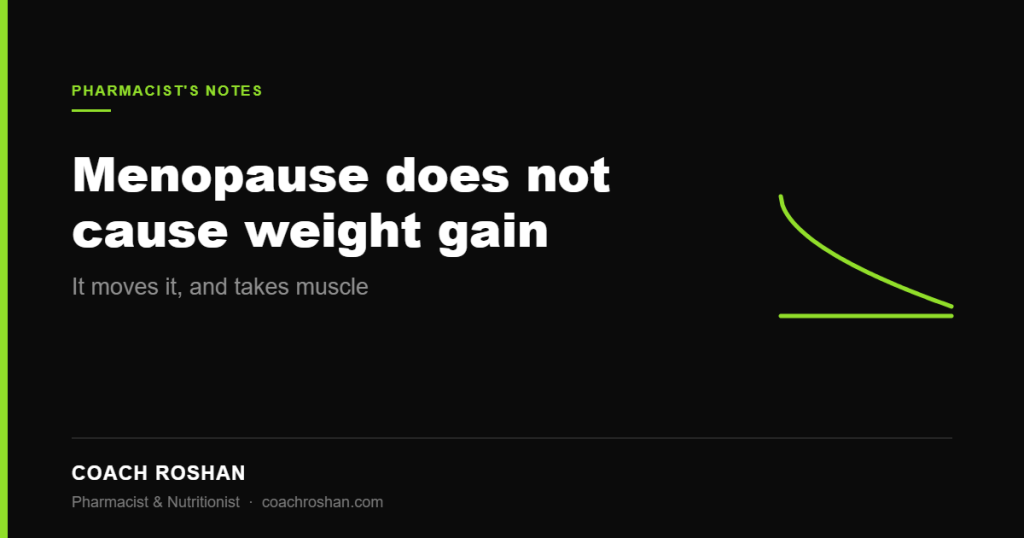
That menopause causes weight gain. It shifts where fat is stored and accelerates muscle loss; the weight itself tracks mostly with ageing and activity.
That a supplement fixes this. The menopause supplement aisle is large and the evidence is thin.
That you should wait it out. The years around the transition are precisely when building muscle and bone pays the largest dividend.
Questions I get asked about this
Will hormone therapy stop the weight gain? It is prescribed for symptoms rather than weight. Some data suggests a more favourable fat distribution on it, but it is not a weight treatment.
Is it too late to start lifting at 52? No. Muscle responds to training at every age studied, including well into the seventies. The gains are meaningful and fast in the untrained.
Why has my cholesterol worsened when nothing changed? Lipids commonly shift unfavourably across the transition independently of diet. It is worth rechecking rather than assuming you did something wrong.
Should I cut carbohydrates? Not necessarily. Protein intake and resistance training matter more, and very low carbohydrate diets are hard to sustain alongside disrupted sleep.
Are hot flushes related to the weight change? They travel together, and disturbed sleep from night sweats worsens appetite regulation. Treating the symptoms can indirectly help.
The short version
- Total weight gain in midlife tracks with ageing more than with menopause
- Fat redistribution to the abdomen is genuinely hormonal, and visceral fat rises sharply across the transition
- Lean mass loss accelerates at the same time, which is the change that alters how you handle food
- Resistance training and adequate protein target the actual mechanism; aggressive dieting worsens it
- Measure your waist, not only your weight
- Check thyroid, glucose, lipids, ferritin and vitamin D — hypothyroidism mimics menopause closely
- Hormone therapy is a real option for symptoms and belongs with a gynaecologist
Before you act on any of this
I am a pharmacist and a nutritionist. I am not your doctor, and this article is general information rather than advice about you specifically. Decisions about hormone therapy and any new medication in perimenopause belong with your gynaecologist. Nothing here is a reason to start, stop or change a prescribed medicine. What this article can do is tell you which questions are worth asking at your next appointment.